
Switzerland is one of the friendliest places in the world to hold assets, and itsreputation matches reality. Private investors here sell BTC at a profit and, in most cases, keep their francs of the gain. It doesn’t mean cryptocurrency lives outside the tax system. Wealth tax, income tax and a set of cantonal rules all […]
30.04.2026

Stock markets have gone through several volatile cycles, inflation has put pressure on households and businesses, and global economic uncertainty is still very much here. Surely, 2026 is already shaping up as another year when people are looking for alternatives to traditional finance. This is not as sudden as the 2020 COVID-19 shock, but the conclusion is similar: the existing financial system still has weak spots, and users keep looking for more flexible ways to store, move and grow capital.
The last few years have put a chill on the global economy and unfortunately (or perhaps, fortunately), they have exposed the weaknesses in our financial and monetary framework. More than anything, it has made us realize we need a strong economic backup plan. Thankfully, amid all this commotion, we’ve found hope in decentralized finance — or open finance, as it’s sometimes called.
Per Consensys, open finance (so aptly named) embodies “the paradigm shift from today’s closed financial system towards an open financial economy based on open protocols that are interoperable, programmable, and composable.” In plain English, DeFi allows anyone worldwide to access digital financial services in a secure, transparent and borderless manner.
Contrary to popular opinion, DeFi does not refer to a solution in itself but rather a collection of digital finance products built on open protocols, tokens and smart contract functionality. These products collectively allow users to fully access capital, invest in various markets and manage their assets.
Thanks to blockchain technology, DeFi processes take place in a decentralized environment without the need for a third party — i.e. banks, financial institutions, companies or governments.
Reviewing the current state of the DeFi landscape

Several crypto media outlets have compared decentralized finance with the failed fundraising model which crumbled under regulatory pressure. Some have incorrectly named DeFi “the new ICO”, but it is so much more…
To begin with, decentralized finance is not a financial model built from scratch. Rather, it’s an intersection of blockchain technology with traditional financial systems. Cryptocurrencies, digital banking and blockchain-based decentralized exchanges are all important in ensuring DeFi breaks into the mainstream.
Decentralized finance is changing the way everyday people view and use financial instruments, both existing and future products. Thanks to DeFi, blockchain technology doesn’t just look ‘promising’ but it’s now able to bring about actual positive change in digital financial services.
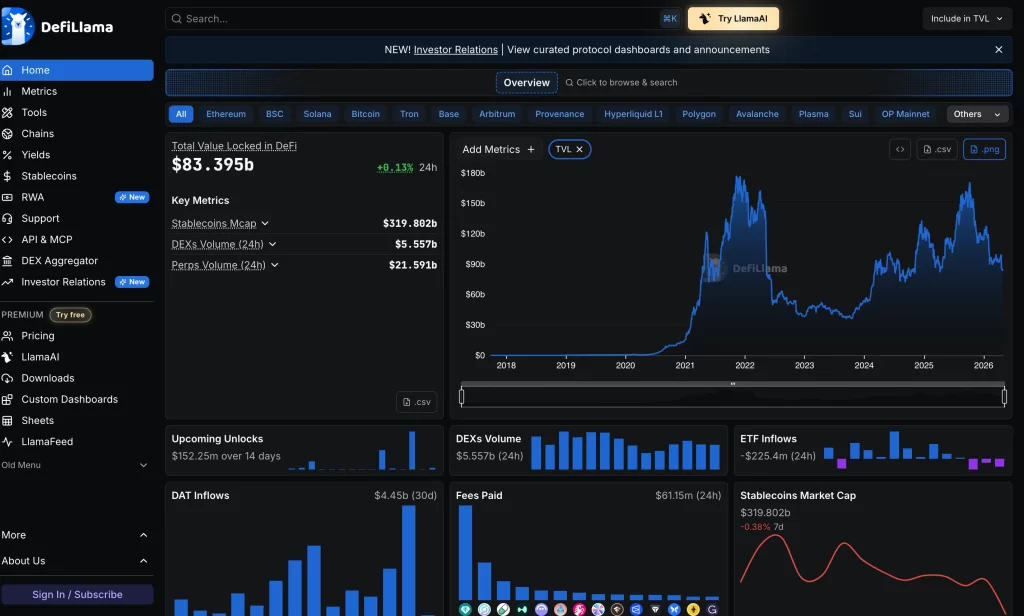
According to DeFiLlama, the value of tokens stored in DeFi smart contracts — known as total value locked, or TVL — is now tracked across thousands of protocols and hundreds of chains. In 2026, DeFi is no longer a small niche measured only in hundreds of millions: the sector regularly moves tens of billions of dollars in TVL, depending on market conditions.
Total value locked in DeFi projects changes with market cycles (Source: DeFiLlama)
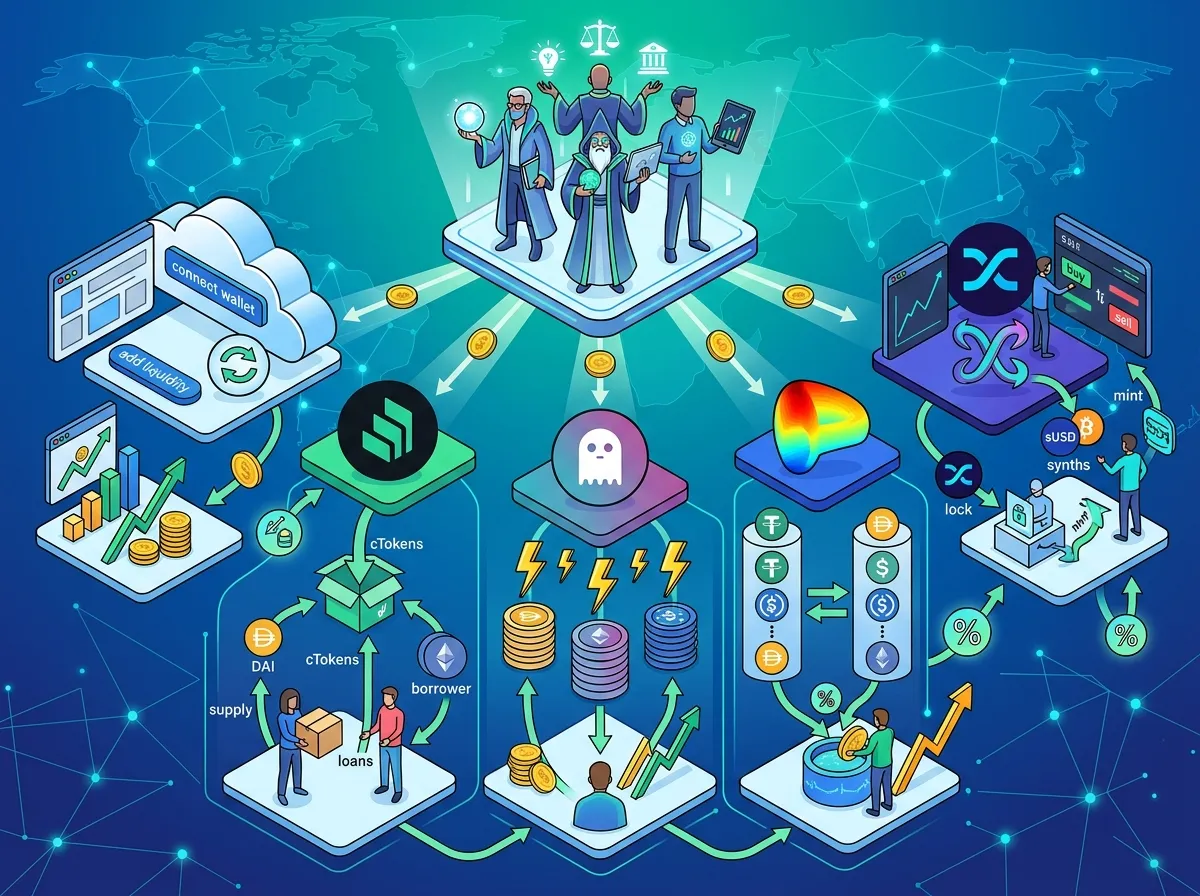
We’ve witnessed first-hand how projects like Sky, Aave, Compound, Synthetix, Curve and others are still important in the DeFi race. They provide various services which allow you to trade on DEXs, earn money with “yield farming” or staking with stablecoins, apply for collateralized loans — or even take out mortgages!
Staking: earn passive rewards through DeFi
As you might probably know, HODLing and trading on exchanges were previously two major ways to make money with cryptocurrency. However, that’s sure to change soon, especially with DeFi’s increasing influence on traditional financial systems. It’s worth mentioning that decentralized lending and staking are gaining popularity in the booming DeFi space. A major reason is they offer cryptocurrency holders (particularly HODLers) a lucrative way to make money auto-pilot.
Staking is simply when you lock up your tokens in a blockchain for a period to help sustain the network. Previously, staking meant helping to validate transactions on a Proof-of-Stake (PoS) network. However, DeFi’s advent has broadened the scope; for instance, you can stake by simply contributing to the liquidity pool on a lending platform.
The major draw of staking is that it can be relatively simple, although it is not risk-free, and your reward depends on how much you stake and for how long. Unlike the energy-intensive Proof-of-Work protocol (Bitcoin and Litecoin) which uses complex computational problems to validate transactions, PoS employs a low-cost, low-energy model of transaction validation.
With higher-than-market interest rates, DeFi lending and staking projects can potentially attract new users looking to earn a steady stream of passive income. This could potentially foster the adoption of cryptocurrencies and digital banking products into the mainstream.
Although lending is a lucrative way to make ‘easy’ money with DeFi, staking is arguably the simplest way to earn passive income on your crypto holdings.
Why you should pick up top projects on DeFiLlama
Currently, there are thousands of DeFi projects, and that number is sure to keep going up. However, we have top platforms in the DeFi ecosystem providing better wealth opportunities than the rest.
In the next sections, we’ll handpick some ‘DeFi leaders’ and briefly explain how you can make money with each one.
How to earn on Aave
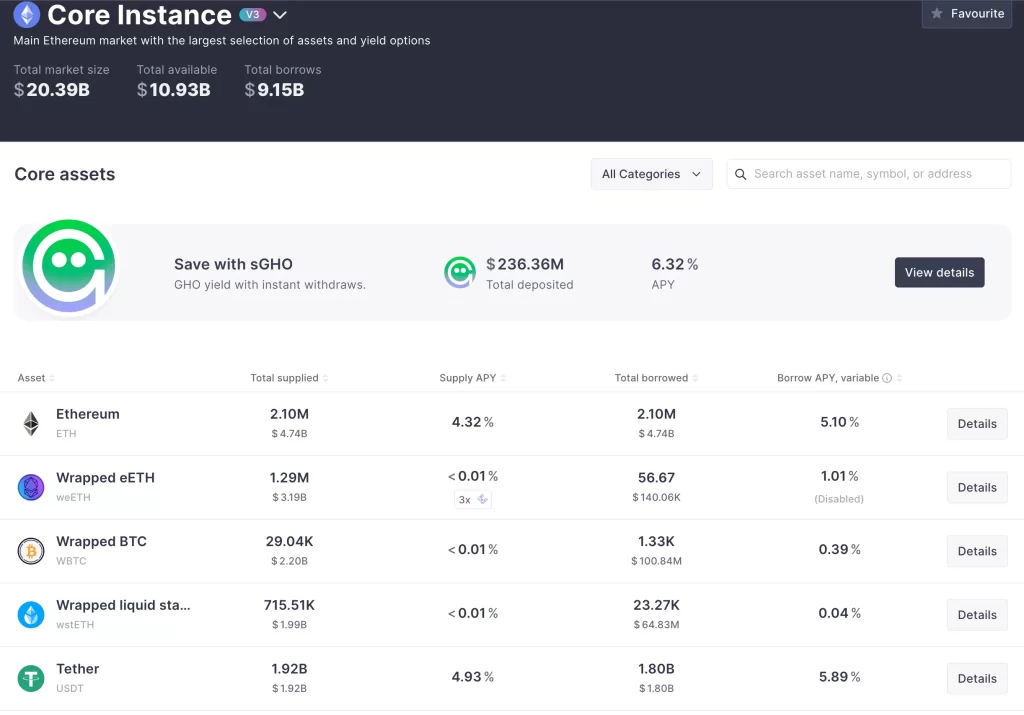
By 2026, Aave remains one of the leading DeFi lending protocols. The platform has moved far beyond its early versions and now operates through Aave V3 markets, where users can supply crypto assets, earn interest, and borrow against collateral.
With Aave, you can earn daily interest on your deposits by providing liquidity to lending pools. Remember, earning rates and borrowing power vary between your deposited tokens. After you deposit, you will receive ‘aTokens’ (i.e., interest-bearing stablecoins pegged 1:1 to your deposited asset). Once you withdraw your deposited assets, the interest earned through the ‘aToken’ will be credited to your account.
Say you deposited 5 ETH, then you’d receive 5 aETH, which will earn you some interest. When you reclaim your 5 ETH, you’ll also get the interest credited to your wallet.
Also, you can borrow different crypto assets and stablecoins, depending on the selected Aave market and network. Borrowed assets will accrue an annual interest which you’ll have to pay back to access future loans, but you can choose between a Stable or Variable interest rate.
How to earn on Sky, Formerly MakerDAO
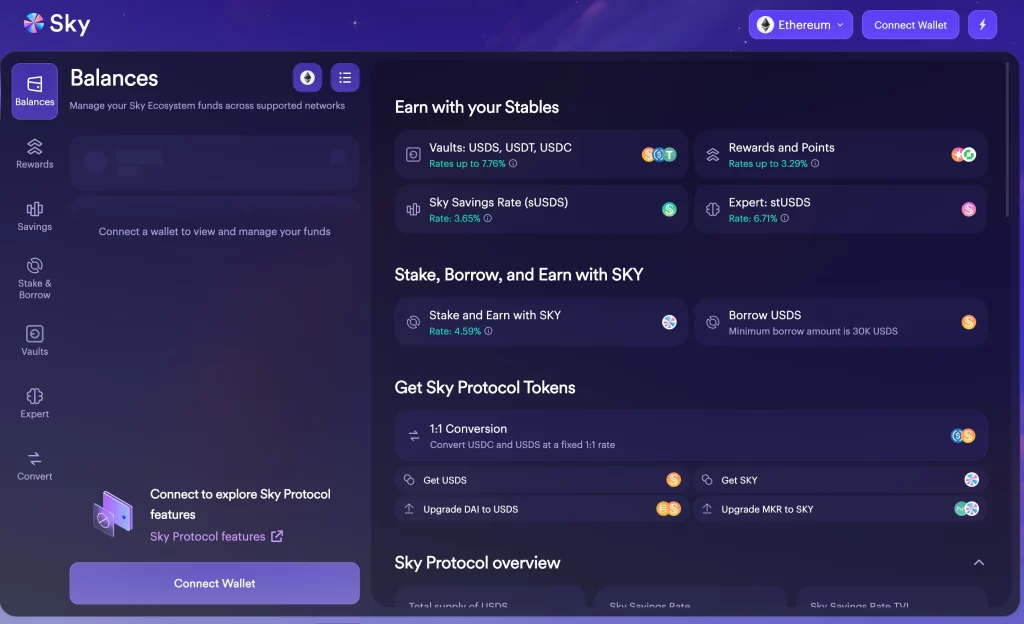
In December 2017, MakerDAO launched Dai on the Ethereum Mainnet. Since then, MakerDAO has become one of the most important names in DeFi and later rebranded to Sky. Dai still exists, but the Sky ecosystem now also uses USDS, sUSDS and SKY. USDS is the newer stablecoin in the Sky ecosystem, while SKY functions as the governance token.
Sky, formerly MakerDAO, is an open DeFi protocol that allows users to work with collateral-backed stablecoins and savings products. You simply open a Maker Vault and deposit your crypto collateral asset into it. Fun fact: Dai is mostly generated through the Maker Vault. You can then spend the generated Dai to buy goods and services within the Maker ecosystem without having to sell your collateralized asset.
Dai usage statistics over time from ‘significant’ addresses
Using Sky.money, users can access stablecoin savings products such as sUSDS through the Sky Savings Rate. The rate changes over time and is not guaranteed, but the basic idea remains familiar: users can put stablecoins to work and earn yield through the protocol.
In case you’re wondering, the yield is not the same as interest from a regular bank account. It depends on protocol mechanics, governance decisions, market conditions and the way Sky allocates stablecoin liquidity.
How to earn on Compound
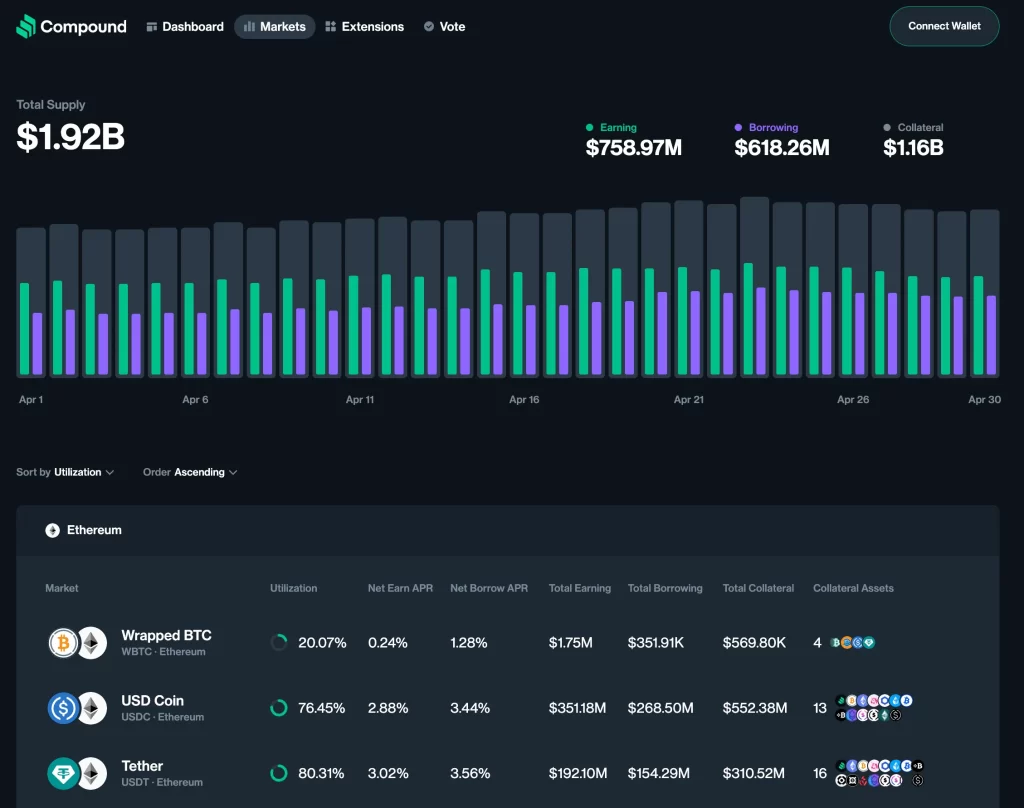
Compound is an open lending protocol that allows you to take and give out loans by locking in your crypto assets as collateral.
Compound’s lending model is similar to Aave: you can contribute to the lending pool and earn interest on your deposits. Moreover, crypto-assets deposited on Compound are converted to Compound tokens (or cTokens) — just as with Aave. In Compound III, also known as Comet, the model is more focused: users can supply crypto assets as collateral to borrow a base asset, while accounts can also earn interest by supplying the base asset to the protocol.
cTokens are simply ERC20 tokens representing anywhere in the world the equivalent of a user’s assets deposited in Compound. By locking ERC20 tokens in the protocol, you get the exact amount in the cToken equivalent. For example, if you lock in 55 dollars worth of DAI in Compound, the system gives you 55-dollar cDAI tokens which automatically earn interest for you. At any time, you can redeem your cDAI for your deposit plus interest accrued — all paid back in DAI.
New cTokens are created whenever users deposit crypto-assets into the Compound protocol. So, by simply holding cTokens and contributing to Compound’s liquidity (either through lending or staking), you’ll earn passive income in decentralized finance.
For lenders, stablecoins such as USDC and DAI are often popular assets for passive returns, but interest rates change depending on supply, demand and market conditions. Keep in mind that interest rates on deposits (and loans) for each collateralized asset is controlled by the asset’s supply and demand.
Available assets depend on the selected Compound market and protocol version.
How to earn on Curve
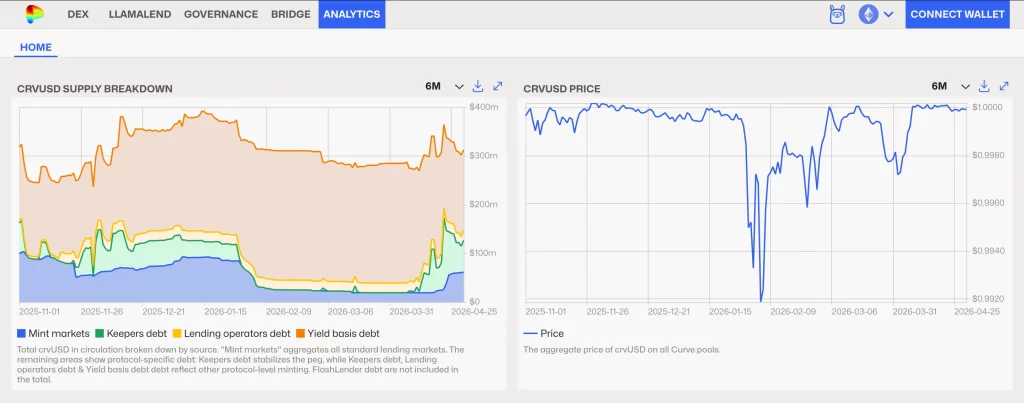
Curve is a decentralized exchange and liquidity pool where you can trade stablecoins and other similarly priced assets with low slippage. In 2026, Curve still plays an important role in stablecoin liquidity, although available pools and assets change over time. You can earn and claim CRV tokens (i.e., Curve’s native utility and governance token) by providing liquidity on any of Curve Finance’s liquidity pools.
Once you deposit your collateral, you’ll receive a counterparty liquidity token. For instance, Curve’s Y pool contains (y)DAI, (y)USDC, (y)USDT and (y)TUSD; these tokens are collectively named yCRV. You have to stake your tokens through Curve to earn CRV.
You can maximize your Curve rewards by locking your vote through the Curve DAO. By vote locking, you can multiply your Curve liquidity rewards by up to 2.5x.
How to earn on Synthetix
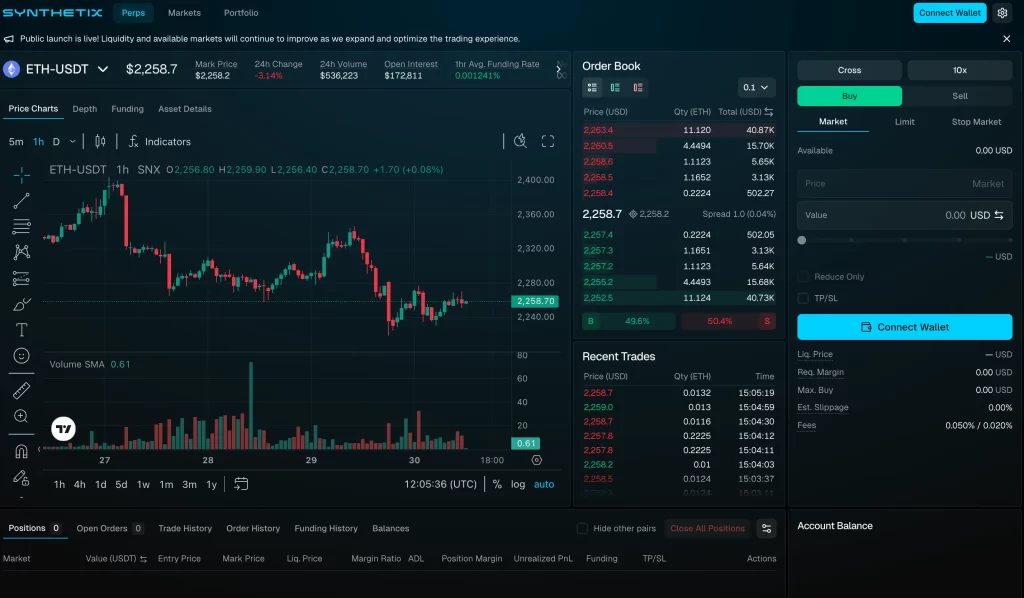
Synthetix allows users to access decentralized derivatives and provide liquidity for on-chain financial products. In 2026, Synthetix is more focused on derivatives infrastructure, including liquidity for perpetual futures and other permissionless derivatives across EVM chains.
You can earn weekly rewards for contributing to the liquidity pool. By locking in your crypto-assets, you’ll mint new Synths. These synthetic assets are then traded by users on Synthetix.Exchange, and you’ll get a part of the trading fees as staking rewards.
Conclusion
Decentralized finance is changing how we DeFine money as we speak. By providing accessible decentralized financial services through open protocols, DeFi aims to give more people direct access to lending, borrowing, trading and yield opportunities.