

Ireland has no separate legislation for cryptocurrency tax. Instead, all digital assets are treated as chargeable assets within the existing tax laws of Capital Gains Tax (CGT) and income tax with corresponding application of Universal Social Charge (USC) and Pay Related Social Charge (PRSI).
24.04.2026


So, you’ve bought some Bitcoin. Maybe a little ETH, a couple of altcoins, or perhaps you’re even staking. And now you’re wondering if the Danish government wants its cut—and exactly how much. The short answer: yes, almost certainly. The long answer: read on.
Denmark’s approach to cryptocurrency taxation is actually clearer than in most countries, which is both good and a little scary. Skattestyrelsen (the Danish Tax Agency) has been building up its knowledge of cryptocurrencies for years, and now it has access to exchange data, blockchain analytics, and—starting in 2026—automatic reporting across the EU via DAC8. Hiding your income is no longer a realistic option.
This guide covers the crypto taxes in Denmark in 2026. The filing deadline is May 1, 2026.
What does not count as a disposition: buying cryptocurrency, transferring coins between wallets you own (though this must be documented), receiving forked tokens during a fork, or simply holding. Please note: transferring cryptocurrency between your own wallets is a tax-free event in Denmark.
What Skattestyrelsen actually thinks about cryptocurrencies
The agency does not consider Bitcoin or Ethereum to be currency—at least not in the legal sense. They are treated as personal assets. In Denmark, cryptocurrencies are considered personal assets and are subject to income tax rather than capital gains tax when sold or traded. Specifically, they are classified as speculative assets. This distinction matters because speculative assets in Denmark are taxed upon realization.
Unrealized gains are not taxed. You can watch your portfolio triple in value and pay nothing until you sell, exchange, or spend it.
But Skattestyrelsen presumes speculative intent by default. In a 2025 ruling (SKM2025.464.BR), a developer claimed he bought Bitcoin in 2011 to test software, not for investment. The court considered his intention, including how much he had purchased, how volatile Bitcoin already was at the time, and the fact that he later sold a portion at a profit. Speculative intent was confirmed, meaning the profit is subject to taxation. If the individual’s intention is found to be non-speculative—such as holding crypto for reasons unrelated to profit—certain holdings may be exempt from taxation.
Lesson: If you don’t have a truly unusual reason for holding cryptocurrency that isn’t related to profit, be prepared to report your gains.
When the tax actually applies
The tax takes effect when you dispose of cryptocurrency. This means selling it for Danish kroner or any fiat currency, exchanging one coin for another (exchanging BTC for ETH is considered a sale of BTC), spending cryptocurrency on anything, receiving it as payment for work, receiving rewards for staking or mining, receiving airdrops, or selling an NFT for an amount exceeding your original purchase price.
What does not count as a disposition: buying cryptocurrency, transferring coins between wallets you own (though this must be documented), receiving forked tokens during a fork, or simply holding.
Personal income, not capital gains
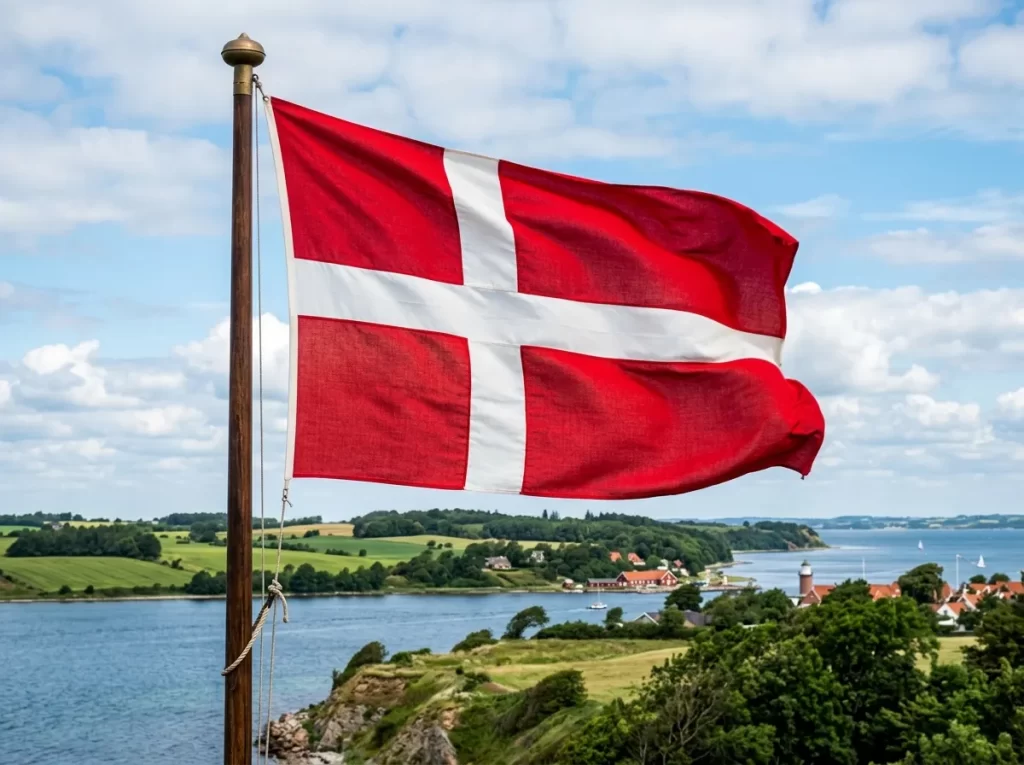
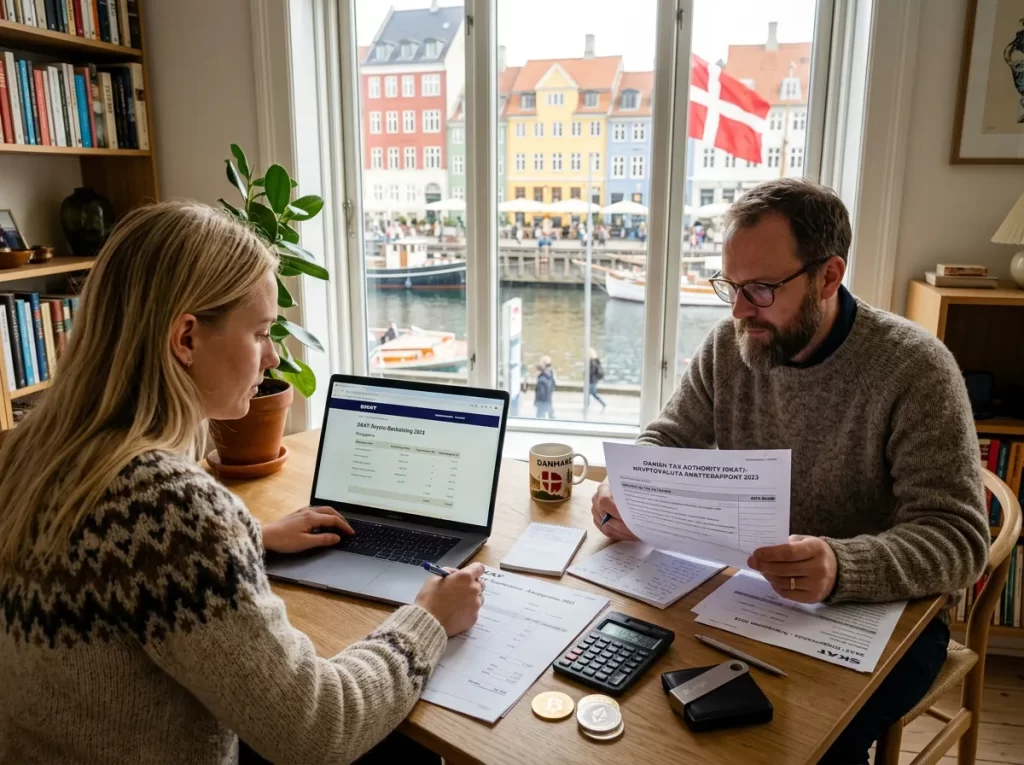
Most cryptocurrency profits in Denmark are subject to income tax, meaning you must pay income tax on gains from crypto sales in addition to your salary, freelance income, and other earnings. The income tax rate can reach up to 56% depending on your total annual earnings and municipality, as both state and local tax (municipal tax) components apply. Tax brackets work as follows: the labor market contribution (AM-bidrag) is 8% of gross income and is withheld first. There is a personal tax deduction of 49,700 Danish kroner—income below this amount is not taxed. The bottom-bracket tax is 12.01%, and for income exceeding 552,500 DKK, an additional top-bracket tax of 15% applies, leading to a maximum effective tax rate of 52.06% on personal income. Municipal or local tax rates (usually 23–27%) are also included in the total tax burden. Many crypto activities, such as trading, mining, staking, and paying transfer fees, are subject to income tax, and you must pay income tax based on the fair market value at the time of each taxable event.
Stablecoins and financial contracts are treated differently—as financial contracts rather than personal assets. Gains from these are classified as capital income and taxed based on specific rules. Cryptocurrencies are generally taxed similarly to other financial assets in Denmark. For capital gains from cryptocurrency, the tax rate is 27% for gains up to 57,200 DKK and 42% for gains exceeding that threshold, making it one of the highest rates in Europe. Report gains in box 346 and losses in box 85.
FIFO rule — No exceptions
Denmark follows the FIFO rule: “first in, first out.” The coins you bought first are considered sold first, with no exceptions and no choice. All holdings of a given coin across all wallets and exchanges are treated as a single pool. To report cryptocurrency taxes in Denmark, you must use the FIFO method to calculate your capital gains and losses, reporting gains in Box 20 and losses in Box 58 of your tax return. It is important to determine the gain or loss for each transaction, and all relevant transactions must be included in your calculations to ensure accurate tax reporting.
Example: Buy 1 BTC in January for 200,000 Danish kroner and another in March for 250,000 Danish kroner. Sell 1 BTC in June for 300,000 Danish kroner. Your cost basis is the January purchase (200,000 Danish kroner), resulting in a taxable gain of 100,000 Danish kroner. Convert each amount to Danish kroner using the exchange rate on the date of each specific transaction.
Gains, losses, and offsetting
If you bought a coin in a single transaction and sold it in several parts during the same tax year, you can combine the results into a single net amount. Net gain → line 20. Net loss → line 58. Offsetting gains and losses is only allowed within the same income year, so you must calculate net gains or losses for transactions that occurred in that period. When making a profit or incurring a loss, it must be reported accordingly.
However, if you buy more of the same coin between these sales, the ability to offset the loss will disappear. You will have to revert to calculating each transaction separately using the FIFO method.
Losses can only be offset by profits from the same type of cryptocurrency—losses on Ethereum do not affect profits on Bitcoin, and cryptocurrency losses cannot reduce income from wages. The deduction for losses is approximately 26–27%, while profits in the top tax bracket are taxed at a rate of 52–56%. This asymmetry is widely considered unfair, and even the Skattestyrelsen’s own advisory body has acknowledged this. So far, nothing has changed.
Mining, staking, airdrops, and everything else
Mining
Mining is treated as income from a hobby business. The fair market value of mined coins on the day of receipt is subject to taxation and must be reported in box 20. Any subsequent profit from the sale of these coins constitutes a second taxable event. If the activity has grown to the scale of a full-fledged business with significant costs for equipment and electricity, these expenses may be deductible—it’s worth obtaining a binding ruling from Skattestyrelsen if this applies to you.
Staking rewards
Staking rewards are taxable upon receipt based on their value in Danish kroner on that day. Then again on any increase in value upon sale. Two separate taxable events from the same activity.
Airdrops
Promotional airdrops with no conditions: taxed upon receipt as personal income. Those earned for performing certain actions—such as platform testing or project promotion—are treated as payment for work. In any case, a subsequent sale creates another taxable event.
Hard forks
Receiving tokens as a result of a fork is not taxable, but the acquisition cost is zero since you paid nothing. Therefore, the entire sale price is subject to taxation when you eventually sell.
DeFi and Liquidity Pools
Depositing funds into a liquidity pool is generally treated as a disposal, as is withdrawing funds. Income and interest are ordinary income. Gas fees incurred upon actual disposal may be deducted from the corresponding profit.
Cryptocurrency as Salary
Payment in cryptocurrency is treated exactly the same as wages in Danish kroner. The fair market value in Danish kroner on the date of payment is your taxable income from employment. Your cost basis is equal to this amount, and any capital gain upon subsequent sale is a separate taxable event.
Gifts, donations, and figures
You can gift cryptocurrency to close relatives tax-free up to a certain threshold—74,100 Danish kroner for 2024 (check the website skat.dk for updated figures for 2025). Immediate family members include children, adopted children, grandchildren, parents, adoptive parents, and people with whom you have lived for at least two years. If the amount exceeds this limit, a 15% gift tax is levied on the excess amount. Both parties must notify the Danish Tax Agency (Skattestyrelsen) by May 1 of the following year.
For people outside this group, small occasional gifts for birthdays or holidays may be tax-exempt if their value is truly low. However, there is no clear definition of “low,” so if in doubt, it is best to declare the gift.
Donating cryptocurrency to an approved charitable organization can be tax deductible in Denmark, allowing for a tax-free transaction up to a certain limit. Donations to approved charitable organizations are eligible for a 26% tax deduction, up to 18,300 Danish kroner per year. Provide the charitable organization with your CPR number so it can file the report directly—otherwise, the deduction will not be automatically applied to your tax bill.
How to file your tax return via the E-Tax portal
Everything is done through TastSelv on the website skat.dk/tastselv. You’ll need your CPR number and E-Tax password (TastSelv code). Don’t have one yet? Request it from the Danish Tax Agency—it will arrive by mail.
The portal opens in mid-March. Your tax return comes pre-filled with information about your employer and bank. You add the cryptocurrency yourself.
Line 20 and Line 58
For Bitcoin and most altcoins: profits are reported on Line 20 (Other personal income), losses on Line 58 (Other Employee Expenses). If line 58 does not appear on your return, call the Tax Agency and ask them to enable it—they will do so. For stablecoins: line 346 for gains, line 85 for losses. All of these entries are made on the E-tax portal page, which is where you submit your annual tax return and report all gains and losses from crypto. Reporting is required for all gains and losses on your annual tax return, which must be submitted by May 1st.
Steps
The way to report crypto taxes in Denmark is through the E-tax portal (skat.dk/tastselv). Taxes are triggered by selling, trading, or spending crypto, and strict reporting is required on your annual tax return (Årsopgørelse). Here’s how to do it:
- Log in to skat.dk/tastselv using your CPR number and E-Tax password
- Click “Ret årsopgørelsen/oplysningsskemaet”
- Go to line 20 and enter your total net profit for the year
- Go to line 58 and enter your total net losses
- Click “Næste” → “Godkend,” then save a copy
You can update your return as many times as needed until May 1. After this date, contact the Tax Administration directly to have the form reopened.
Accounting and software

The Tax Agency may request a history covering up to five years. You must maintain detailed records of all transactions for at least five years, including receipts and exchange statements. For each transaction, record: the date, the cryptocurrency, the amount, the value in Danish kroner at the time based on the exchange rate on the transaction date, the fee, the exchange or wallet, and the transaction ID (TXID). At the end of the year, export CSV files from the exchanges. For DeFi transactions that cannot be exported, take screenshots.
For a few transactions on a single platform, a spreadsheet will suffice. For anything more complex—multiple exchanges, staking, DeFi, airdrops—the manual approach becomes highly prone to errors. We recommend using crypto tax software for anyone with more than a few transactions. Tools such as Koinly, Divly, and CoinLedger make it easy to import your entire history, apply the FIFO method, handle conversion to Danish kroner, and generate reports ready for submission to Danish authorities, significantly reducing manual effort. Most of them cost around 50 euros per year for a substantial portfolio.
Tax Payment and Deadline
In Denmark, it is essential to be aware of the annual tax return deadline for reporting and paying taxes on your cryptocurrency gains. For most taxpayers, the deadline falls in early May, with the exact date announced each year by the Danish Tax Agency (Skattestyrelsen). Missing this deadline can result in penalties or interest charges, so it’s important to mark your calendar and prepare your information in advance.
When you are ready to pay, you will use the E-tax portal (TastSelv) to fill in your tax return. Make sure you have all the necessary data at hand, including the acquisition cost, purchase price, and sale price for each cryptocurrency transaction. Accurate records of your purchases and sales are crucial for determining your taxable income and ensuring your return is correct.
If you have questions about the process or need clarification on specific transactions, the Skattestyrelsen website offers detailed guidance, and you can also contact their support for assistance. Remember, keeping thorough documentation of your cryptocurrency transactions will make it much easier to fill out your tax return and avoid any issues with your tax assessment.
Tax Records and Audit
Keeping accurate and comprehensive records of your cryptocurrency transactions is not just good practice—it’s essential for your annual tax return and for compliance with Danish tax law. You should document every purchase, sale, trade, and mining reward, as well as any other income sources related to crypto. This includes saving orders, invoices, receipts, and any other correspondence or information that supports your reported figures.
If you engage in mining, make sure to record the value of mining rewards at the time they are acquired, as well as any subsequent sales. The Danish Tax Agency may request to see your records for previous years, especially if your tax return is selected for audit. Being able to provide clear documentation for all your cryptocurrency transactions, including sales and other income, will help you respond quickly and accurately to any inquiries.
By maintaining organized records, you not only make the process of filing your tax return easier, but you also protect yourself in case of an audit. This proactive approach ensures you can verify your reported income and deductions, reducing the risk of penalties or disputes with the tax authorities.
DAC8: why it matters starting in 2026
Starting in 2026, the EU’s DAC8 directive requires crypto exchanges to automatically report user data to national tax authorities. Skattestyrelsen has been requesting data directly from exchanges for years—DAC8 simply makes this mandatory for all platforms. If you have undeclared income from previous years, voluntarily correcting this now will be much less painful than if you are caught.
How to legally reduce your tax liability
Selling losing positions by December 31 allows you to claim a deduction against profits from the same coin for the year. Just follow the offsetting rules—buying more of the same coin between sales will forfeit this opportunity.
If your total income, including cryptocurrency gains, is close to the 49,700 DKK tax-free allowance, deferring the sale to the next year could save you a significant amount in taxes. Spouses can transfer unused allowances to each other, which can sometimes significantly change the calculation.
And if you have a large profit, spreading the sale over two tax years can keep you from falling into the highest tax bracket in each of them. This is legal and worth considering.
Tax Compliance and Penalty
Staying compliant with Danish tax regulations is essential when dealing with cryptocurrency. You must be aware of the rules and ensure that your annual tax return is filed on time, with all required information accurately reported. Failing to meet these obligations can make you liable for penalties, fines, or even legal action.
It is your responsibility to keep up to date with the latest tax laws, submit your tax return within the specified time frame, and pay any taxes owed. If you are unsure about any aspect of your tax situation, it is highly recommended to consult a tax professional or advisor who can help you navigate the requirements and avoid costly mistakes.
Remember, timely compliance not only helps you avoid penalties but also gives you peace of mind. By being proactive and diligent, you ensure that your crypto activities are fully in line with Danish tax law, protecting yourself from unnecessary financial and legal risks.
Mistakes to avoid
Failing to report small transactions. The exchange data provided by Skattestyrelsen is detailed enough to reveal gaps even in the case of small staking rewards and minor transactions.
Aggregating losses across different coins. A loss on Ethereum and a profit on Bitcoin are completely different things. Always. The principle here is that each cryptocurrency is treated as a separate asset for tax purposes, so gains and losses must be calculated individually.
Using the wrong exchange rate. The rate on the day of each transaction—not the monthly average or today’s rate. This principle ensures that taxable amounts accurately reflect the value at the time of each transaction, as required by Danish tax authorities.
Considering Section 20 only for sell orders. Staking income, mining rewards, and airdrops received during the year also fall under this section.
FAQ
If I never sell, do I have to pay anything?
No. Hold as much as you want—tax is only assessed when you dispose of the asset.
What if I lose access to my wallet?
Skattestyrelsen does not consider the loss of access to a private key as a disposal of the asset. No deduction applies.
Do I need to file a tax return if I only incurred losses?
Yes—Section 58 records the deduction and creates an entry for carryover to future years.
How do I report non Danish income from crypto?
If you have non Danish income, such as crypto rewards or earnings from abroad, you must report it separately from your Danish income. Make sure to follow the specific submission deadlines for foreign income.
What documentation should I keep for my crypto taxes?
You should keep all transaction records, including receipts, statements, and other correspondence information such as emails and communications, to support your profit and loss calculations.
Where is the right place to file my crypto taxes?
The correct place to report your crypto taxes is the E-tax portal (TastSelv) or the relevant reporting platform specified by Skattestyrelsen.
Is the portal available in English?
No—only in Danish. Software platforms for calculating cryptocurrency taxes usually fully support English and generate reports that you can work with.
Do I need to report crypto activities every year?
Yes, crypto activities must be reported annually with supporting data. The tax year in Denmark runs from January 1st to December 31st.