


Ireland has no separate legislation for cryptocurrency tax. Instead, all digital assets are treated as chargeable assets within the existing tax laws of Capital Gains Tax (CGT) and income tax with corresponding application of Universal Social Charge (USC) and Pay Related Social Charge (PRSI).
23.12.2025


Crypto and trading have become very popular over the last 5–6 years. Many newcomers try their hand at this. However, before getting started, it is crucial to learn about all the potential pitfalls on the way to success. The legislation concerning crypto taxes varies from country to country.
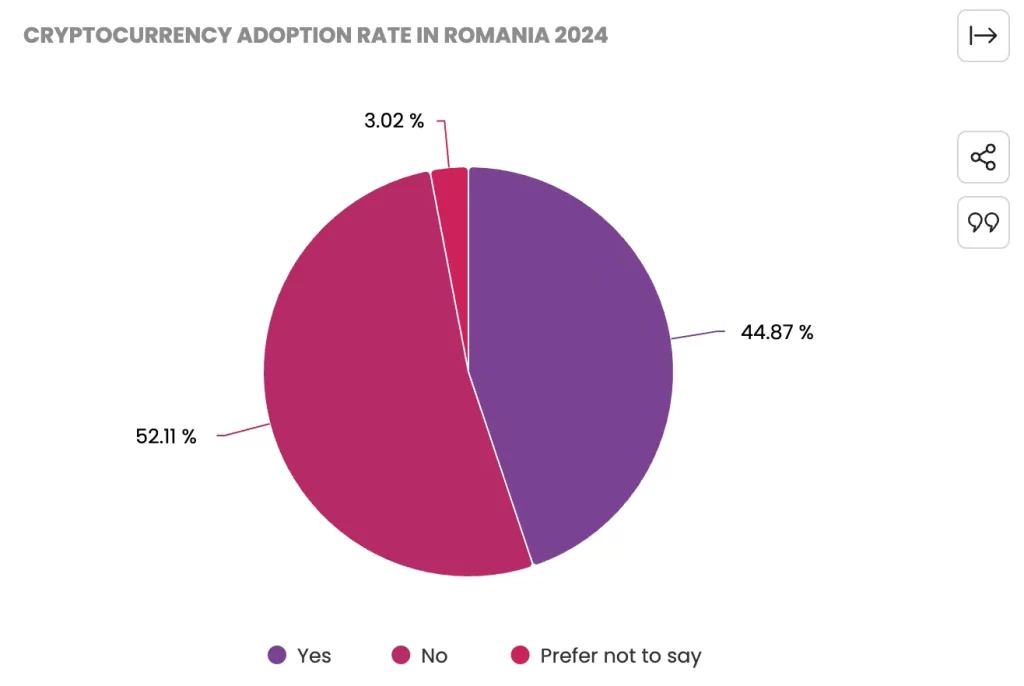
According to the TGM Global Crypto Insights Report 2024, the mass adoption of cryptocurrencies in Romania is increasing year on year. More than 44% of Romanians have owned or used cryptocurrency, while 52.11% have not. This suggests that Romania is a user-friendly country for crypto technologies. Moreover, adoption rates may rise if education is provided and more entry points (exchanges, airdrops, etc.) are made available in this country.
If you’re wondering how much tax you’ll pay in Romania, this article will help you find out.
Does one have to pay taxes on crypto in Romania?
Yes, anycrypto profits made in Romania are subject to Income Tax. TheAgenţia Naţională de Administrare Fiscală (ANAF) is about to issue a fullguidance on the taxation of cryptocurrency assets. In November2024, the Romanian Parliament amended the guidance on cryptocurrency revenue related to individuals until 31July 2025.
The Chamber of Deputies adopted the Law on the approval of Government Emergency Ordinance with 158 votes(40 against). This law aimed to regulate fiscal and budgetary measures for managing budgetary receivables. Initially, there was nothing related to crypto, but one of the deputies managed to make some amendments to the law. However, President Iohannis has not yet promulgated this law.
Therefore, the crypto income taxes in Romania are unchanged till now.
How is crypto taxed in Romania?

How is crypto taxed in Romania?
The Romanian government does not recognise crypto as legal tender under Romanian law. However, they are considered income from alternative sources and are subject to Income Tax. Virtual crypto transfers are regulated by Article 116(1) of Law 227/2015. It states that crypto income falls are considered income from alternative sources. Therefore, you are responsible for calculating your income and report it to the Agenţia Naţională de Administrare Fiscală (ANAF).
On Monday, 13 January 2025, ANAF issued the PDF for submitting the 2025 Single Declaration online. This made it easier to fill in all the
The type of taxation in Romania depends on whether your cryptocurrency is viewed as a capital gain or income.
What are the main taxable events in Romania?
Crypto gains
Any disposal of cryptocurrency, including selling it for fiat currency, swapping it for another cryptocurrency, or spending it on goods and services, is a taxable event. You’ll therefore need to calculate your gain or loss. If you have made a gain, you will pay income tax on that gain. If you have made a loss, you don’t need to pay anything.
Mining and staking rewards
These rewards may be considered additional income, so you’ll need to pay Income Tax on them based on their fair market value in RON on the day you receive them.
In summary, Crypto Income Tax includes:
- Mining crypto assets
- Staking crypto assets
- Earning new tokens through DeFi protocols
- Earning new tokens via third-party products (investment, earn instruments etc.)
How much tax is payable on cryptocurrency in Romania?
How much tax is payable on cryptocurrency in Romania?
Currently, a 10% tax is levied on income received from cryptocurrency transactions and interest obtained through staking. However, if your earnings are less than 200 lei, they won’t be taxed. Furthermore, if your total earnings are less than 600 lei, you won’t have to pay any tax either.
You will also have to pay the health contribution (CASS) if your crypto income exceeds the 6-, 12- or 24-gross-minimum-wage thresholds. In 2025, the national gross minimum wage in Romania is 4,050 RON per month.
Cryptocurrency Tax thresholds
CASS – pension contributions
There are three tax thresholds for CASS pension contributions in Romania.
- Below 12 gross minimum wages (below 48,600 RON/year) – No CASS contribution is needed.
- Between 12 and 24 gross minimum wages – you’ll pay 12 minimum wages (48,600 RON).
- Over 24 gross minimum wages (over 97,200 RON/year) – you’ll pay 24 minimum wages (RON 97,200).
CASS – social health contributions
There are four tax thresholds for CASS social health contributions in Romania.
- Under 6 gross minimum wages (under 24,300 RON) – No CASS contribution is needed.
- Between 6 and 12 gross minimum salaries (24,300 – 48,600 RON) – you’ll pay 6 minimum wages (24,300 RON)
- Between 12 and 24 gross minimum wages (48,600 – 97,200 RON) – you’ll pay 12 minimum wages (48,600 RON)
- Over 24 gross minimum wages (over 97,200 RON) – you’ll pay 24 minimum wages (97,200 RON)
Crypto tax example for Romania
The Romanian tax year runs from 1 January to 31 December each year. Taxpayers with revenue from alternative sources, such as cryptocurrency, must file their annual tax return by 25 May of the following year.
Let’s consider a few examples.
Example 1
Ana (Romanian tax resident) buys 0.10 BTC in 2025 and later sells it for a profit. In Romania, crypto “transfer” includes selling and also exchanging/disposing (including swaps or paying for goods/services).
Buy (March 2025): 0.10 BTC for 18,000 RON + 90 RON fee → acquisition cost = 18,090 RON
Sell (Sept 2025): 0.10 BTC for 23,500 RON − 120 RON fee → net proceeds = 23,380 RON
Taxable gain: 23,380 − 18,090 = 5,290 RON
Income tax (10%): 10% × 5,290 = 529 RON
Romania taxes the positive difference between selling price and acquisition price, including direct transaction costs, at 10%.
Ana reports and pays via the Single Tax Return (Declarația unică) by 25 May of the following year (so, for 2025 income → by 25 May 2026).
Example 2
If Ana makes a few small disposals in 2025 with profits like:
150 RON, 180 RON, 170 RON → total annual gains = 500 RON
Because each gain is under 200 RON per transaction and the total gains for the year don’t exceed 600 RON, these gains are not taxed under the exemption rule.
Practical note (RON conversion)
When filling in the tax return, amounts are expressed in RON; amounts in foreign currency are converted using the NBR (BNR) exchange rate applicable at the time the price is received.
Optional note (health insurance contribution – CASS)
Depending on your total non-salary income (which can include “other sources”), you may also trigger CASS (10%) if you exceed the threshold of 6 gross minimum wages (shown as RON 24,300 for 2025), with the contribution base set at 6 / 12 / 24 minimum wages depending on total income level.
Is any crypto tax free?
Yes, there are situations in which you don’t have to pay anything for cryptocurrency-related activities.
- Gifting or receiving crypto as a gift. Romania doesn’t have a gift tax, so no special taxesapply in this case.
- Buying crypto with fiat currency (lei or euros).
- Holding crypto: it doesn’t matter whether you hold crypto in the short term or long term; there’s no wealth tax in Romania, so you won’t have to pay tax on it.
- Transferring crypto between your wallets: Moving crypto between two of your own addresses is not taxable.
Conclusion

Romania’s crypto rules are simple in principle: if you realize a profit, you may owe tax. Crypto is not treated as legal tender, so gains from disposing of virtual currencies – selling for fiat, swapping into another coin, or spending crypto on goods/services – can create taxable income. The taxable gain is generally the sale value (minus direct fees) minus your acquisition cost (plus direct fees). If you lose money on a disposal, you typically don’t owe income tax for that transaction, but you should still keep records.
Income can also arise from mining, staking, and similar reward mechanisms, usually valued at fair market value on the day you receive the coins. Keep a clean ledger: dates, quantities, wallet addresses, exchange statements, fees, and the price used for valuation. If transactions involve foreign currency, convert amounts into RON using the relevant official exchange rate for the transaction date.
The Romanian tax year is calendar-year, and individuals report via the annual tax return due the following year. Depending on your total non-salary income, you may also trigger health contributions once you cross the statutory thresholds linked to the gross minimum wage. Good bookkeeping is the difference between a smooth filing and expensive surprises.