
Switzerland is one of the friendliest places in the world to hold assets, and itsreputation matches reality. Private investors here sell BTC at a profit and, in most cases, keep their francs of the gain. It doesn’t mean cryptocurrency lives outside the tax system. Wealth tax, income tax and a set of cantonal rules all […]
22.01.2026


AMP crypto entered the scene with a bright promise — to become digital collateral for instant, verifiable value transfer. AMP claims to enable quick and irreversibly secure transactions across a range of asset-related use cases. But with AMP’s price dropping from its all-time high, and market confidence weakening, all crypto enthusiasts are asking: Is AMP still a good investment?
What is AMP and how does it work?
AMP is an ERC-20 token designed to support value transfer activities by offering collateralization services on the Ethereum blockchain. Its purpose is to minimize fraud risks and guarantee settlement, particularly in merchant payments and other decentralized financial transactions.
The key technical concept behind AMP is its system of collateral partitions and collateral managers. This structure allows developers to redirect collateral, lock, release, or carry balances through smart contracts and predefined partition strategies.
AMP supports a wide range of asset-related scenarios, from fiat transactions to cryptocurrency exchanges, and is designed with a straightforward but versatile interface to ease developer integration.
AMP smart contracts and flexa network integration
At the heart of AMP’s application is its integration with Flexa, a blockchain payments company based in the U.S. Flexa lets users pay with crypto at brick-and-mortar retailers while ensuring the vendor receives payment instantly in fiat. AMP serves as the collateral token, backing every Flexa transaction with verifiable assurances.
But the dependency on a single payment network called Flexa still can be counted as vulnerability. Despite AMP’s support for a wide variety of asset-related use cases, real-world adoption outside the Flexa ecosystem is minimal.
AMP tokenomics and circulating supply
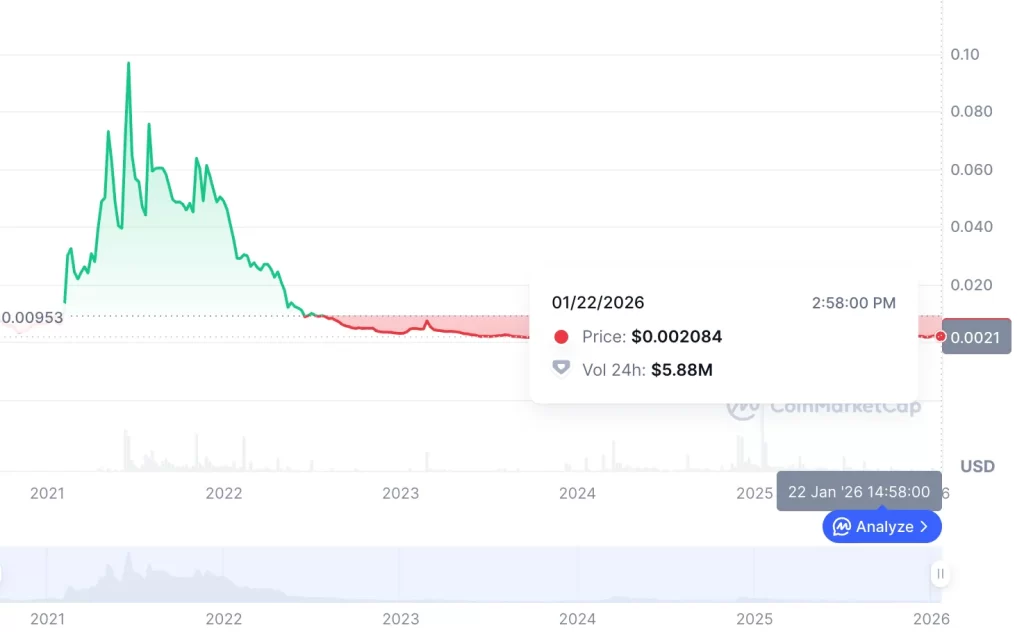
- AMP’s supply: 99.4B tokens total
- Circulating supply: Over 42 bln AMP
- Market cap (as of 2026): ~$130 mln
- Trading volume: Decreasing steadily
Although AMP was once ranked among the top 50 cryptocurrencies, its market cap has dropped dramatically from its 2021 peak.
Amp price history: from hype to reality
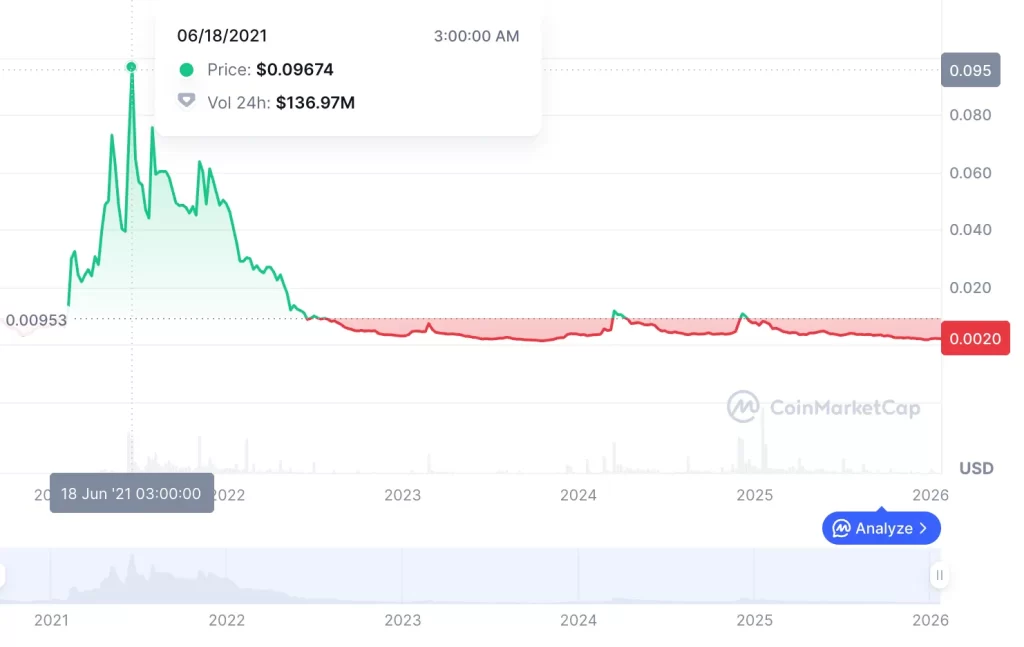
- All-time high: $0.121 (June 2021)
- Current price: ~$0.003 (January 2026)
- Highest price paid: Nearly 40x current value
What was AMP’s all-time high?
AMP hit its ATH in 2021 during the super bullish crypto market — fueled more by speculative momentum than utility traction.
Can AMP reach $1? Will it ever recover?
Let’s do the maths. For AMP to reach $1 per token, it would require a market capitalisation of almost $100 billion — higher than Ethereum’s current valuation. Given AMP’s limited adoption and stagnant ecosystem growth, not to mention its fading use cases, there is little hope that this scenario is mathematically possible, unless there is an extreme supply burn or a revolutionary utility breakthrough.
So, will the AMP coin ever recover? It may stabilise or experience short-term price increases, but a true “comeback” seems unlikely without deeper innovation and wider adoption of the ecosystem outside of Flexa.
Collateral partitions: A clever idea, poorly monetized
One of AMP’s most distinctive features is its collateral partition system. These allow for the creation of separate collateral pools tied to individual use cases, which enhances security and enables special capabilities such as lock-release-redirect functions.
However, this innovation has not led to significant developer engagement or major integrations outside of its original context. For AMP to grow, it needs more than just a neat architecture — it needs real-world demand.
Is AMP a good investment in 2026?
AMP might be worth watching for its conceptual framework, especially around smart contracts and digital collateral models. But from a critical investor standpoint, the following red flags emerge:
- Declining price with no recovery trend
- Over-reliance on Flexa with limited diversification
- Stagnant ecosystem development
- No major new partnerships since 2022
- Limited momentum despite rising DeFi interest
AMP is highly speculative and unlikely to provide substantial gains without major ecosystem shifts. For most investors, it’s a high-risk, low-liquidity asset better suited for short-term trading than long-term holding.
AMP markets: where to buy or trade AMP
You can buy AMP on several centralized crypto exchanges, including:
- Coinbase
- Binance (limited pairs)
- Crypto.com
- KuCoin
- Buycoin
However, note the low trading volume, especially outside U.S. platforms. Liquidity has dropped over 60% year-over-year, making slippage and volatility more likely during larger trades.
AMP collateral use cases: still relevant?
AMP supports:
- escrow functions for DeFi lending.
- retail payments via Flexa
- collateral for NFT transactions
- micropayment security
However, despite AMP’s claims that it enables a wide variety of value transfer activities, few of these have led to widespread adoption. Competitors such as Chainlink, Quant and traditional stablecoins now handle many similar use cases and have greater traction.
Verifiable assurances and transparency: still trustworthy?
AMP markets itself as providing instant verifiable assurances and directly verifiable settlement. Technically, these features are functional. But questions remain:
- Who audits AMP smart contracts?
- What entities manage the collateral partitions?
- Is governance truly decentralized?
Transparency, while present on a technical level, is lacking in terms of strategic updates, roadmaps, and community involvement.
AMP today: A digital collateral token in decline?
AMP today remains listed across major platforms, but enthusiasm has dwindled. It’s been over two years since the last major update, and even in bullish market cycles, AMP fails to attract serious investor capital.
The concept of predefined partitions, the ability to release and redirect collateral, and its collateral models are technically sound — but insufficient without traction.
Should you add AMP to your portfolio?
AMP crypto has strong ideas on digital collateralization and smart contract design, but it suffers from:
- A shrinking market cap
- Disconnected development roadmap
- Over-reliance on one ecosystem (Flexa)
- Unrealistic expectations (AMP to $1?)
If you’re a high-risk DeFi trader seeking niche plays with theoretical upside, AMP may have some appeal. But for most serious investors, it remains a cautionary case of overhyped tech underdelivering in practice.
📊 AMP by the numbers
AMP Price ~$0.003
All-Time High $0.121
Circulating Supply 42B+
Market Cap ~$130M
AMP needs a second Act — or a goodbye
The AMP token was built on promising ideas, but has failed to evolve. Its value proposition — digital collateral for value transfer — remains strong in theory but weak in execution.
Until the AMP network expands meaningfully beyond Flexa or integrates into larger DeFi ecosystems, it will likely continue its decline in relevance.